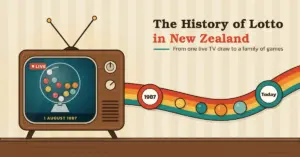
New Zealanders have been checking Lotto numbers since 1 August 1987, when the first draw was broadcast live on television. In the decades since, the national lottery has grown from a single weekly game into a family of products — Strike, Keno, Powerball, Bullseye and the Instant Kiwi scratch tickets — and has changed hands in name from the New Zealand Lotteries Commission to Lotto New Zealand. This article walks through that history in order: why the country set up a lottery, what the first draw looked like, how the games arrived, and the big format changes right up to the September 2026 Powerball overhaul.
Before Lotto: Golden Kiwi and the case for a national lottery
New Zealand ran state-sanctioned lotteries long before 1987. The best known was the Golden Kiwi, a ticket lottery that raised money for community causes through much of the twentieth century, alongside the older “Art Union” draws. By the mid-1980s the government wanted a modern, number-picking game of the kind already popular overseas.
The state-owned New Zealand Lotteries Commission was established in June 1987 to run the new game, and the existing Golden Kiwi lottery was placed under its authority. If you want the governance side in detail — the Crown entity structure and who answers for it today — see our explainer on who owns Lotto in New Zealand.
The first draw: 1 August 1987
Tickets went on sale on 22 July 1987, and the first live draw took place on 1 August 1987. It was a television event: radio presenter Doug Harvey and dancer Annie Wilson hosted, the numbered balls tumbled in a large clear barrel, and scrutineers sat in the studio to confirm the result was fair. The very first ball drawn was number 4, and that opening draw carried a Division One prize pool of about $359,808.
The core game has stayed recognisable ever since. Players choose six numbers from a pool of 40, a bonus ball is drawn as well, and matching all six wins the top division. At launch it was a once-a-week game and a line cost 50 cents.
A growing family of games (1989–2009)
Once Lotto was established, the Commission steadily added new ways to play. Each had its own rules, odds and price, but all sat under the same national brand.
- Instant Kiwi (1989): scratch-and-win tickets that replaced the old Golden Kiwi and gave players an instant result instead of waiting for a draw.
- Lotto Strike (1993): an add-on in which you pick four numbers and must match them to the first four main Lotto balls in exact order. You can read how it works, and what the tiers pay, in our guide to what Lotto Strike is and how it works.
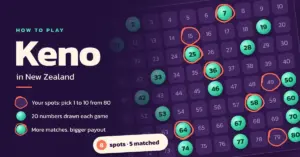
- Keno (1994): a fast draw game where you pick a handful of numbers from a field of 80, now with several draws a day.
- Powerball (2001): an optional extra number that turns a Lotto win into a much larger jackpot — the game most responsible for the multi-million-dollar headlines.
- Big Wednesday (2005): a separate midweek game with cars and cash prizes, later retired in 2015.
- Bullseye (2009): a daily game based on picking a six-digit number.
Lotto NZ milestones
| Year | Milestone |
|---|---|
| 1987 | First Lotto draw (1 August); a weekly six-from-40 game at 50 cents a line |
| 1989 | Instant Kiwi scratch tickets replace the Golden Kiwi |
| 1993 | Lotto Strike launches as an add-on game |
| 1994 | Keno begins |
| 2001 | Powerball added as an optional extra number |
| 2005 | Big Wednesday launches (retired 2015) |
| 2008 | MyLotto online sales go live (May) |
| 2009 | Bullseye daily game launches |
| 2013 | The Lotteries Commission starts trading as Lotto New Zealand |
| 2017 | Lotto line price rises to 70 cents; Powerball cap lifts to $50m |
| 2026 | Powerball moves to 14 balls; jackpot cap rises to $60m |
From the Lotteries Commission to Lotto NZ
Two changes in this period shaped how the lottery looks today. First, the operator moved online: the option to buy Lotto online arrived with the launch of the MyLotto website in May 2008, letting players buy tickets and check results without visiting a shop. Second, in 2013 the New Zealand Lotteries Commission began trading publicly as Lotto New Zealand — the name on tickets and advertising ever since, though the Commission remains the legal entity behind it.
Throughout, the lottery has operated as a state-owned Crown entity under the Gambling Act 2003, which is also the law that steers its profits toward community causes rather than private shareholders.
How the games have changed over the years
The headline numbers people remember — ticket prices and jackpot caps — have been adjusted several times as costs and prizes rose.
- Lotto line price: a single line started at 50 cents, rose to 60 cents in 2004, and reached 70 cents in April 2017.
- Powerball’s extra ball: at launch in 2001 the Powerball number was drawn from a pool of eight. That grew to ten in 2007, and to 14 in 2026 (more on that below).
- Jackpot ceilings: Powerball’s maximum jackpot was lifted in stages — reaching $50 million in 2017 — with a “Must Be Won” draw forced once the cap is hit and nobody wins.
- Retired games: Big Wednesday ran its final draw in 2015, trimming the line-up back toward the core Lotto, Strike, Powerball, Keno, Bullseye and Instant Kiwi games sold today.
Those bigger ceilings are why record prizes have climbed over the years. For the full roll of record jackpots and who took them home, see the biggest Lotto win in NZ.
The 2026 Powerball overhaul
The most significant change in nearly two decades landed in September 2026. In September 2026, the number of Powerball balls increased from 10 to 14, with the first draw under the new format held on Wednesday 16 September 2026. The shake-up changed several things at once:
- Harder top prize: the odds of winning Powerball’s Division 1 lengthened from about 1 in 38.4 million to about 1 in 53.7 million for every line.
- Bigger jackpots: the starting jackpot rose from $4 million to $5 million, and the maximum climbed from $50 million to $60 million.
- A new Division 8: a fixed $12 prize for matching fewer numbers. Lotto NZ expected about 9,000 fewer winners each week across Divisions 1 to 7 under the longer odds, but said the new division would more than make up for it — lifting the total number of weekly Powerball winners by around 30% (from roughly 47,000 to 62,000).
- Same price: the cost to play was left unchanged.
The net effect, as Lotto NZ described it: longer odds at the very top, but more frequent small wins and a jackpot more likely to roll over into larger prizes.
Where the money goes
Lotto has always been pitched as a lottery with a community purpose. After prizes, tax and running costs, its profits pass to the New Zealand Lottery Grants Board (Te Puna Tahua), which is serviced by the Department of Internal Affairs. The Board sets the policy for how that money is shared and directs it to grants for recreation, the arts, community projects and sport across the country. That funding link — not just the prizes — is a large part of why the game was created as a state-owned operation in the first place.
A note on playing responsibly
This article is general information about the history of Lotto in New Zealand. It is not advice to play. Buying Instant Kiwi scratch tickets is already restricted to people aged 18 and over, and the government is moving to extend an 18-and-over limit to all Lotto products, in stores and online. A lottery is a game of chance: the odds are fixed, no system or past result changes them, and Lotto is best treated as entertainment rather than a way to make money. If gambling is causing harm for you or someone you know, help is available around the clock from the Gambling Helpline on 0800 654 655. You can also read our responsible gambling page.
Sources
- Wikipedia — Lotto New Zealand (founding, game launch years, prices, 2013 rebrand, Gambling Act 2003)
- 1News — Newsmakers: looking back at NZ’s first-ever live Lotto draw
- 1News — ‘Gamechanger’: Major changes coming to Lotto Powerball
- 1News — Why tonight’s Lotto jackpot will be harder to win
- 1News — Sale of Lotto tickets to under-18s to be banned
- govt.nz — New Zealand Lottery Grants Board (Te Puna Tahua)
- Safer Gambling — Gambling Helpline 0800 654 655
Frequently asked questions
When did Lotto start in New Zealand?
Tickets first went on sale on 22 July 1987, and the first live Lotto draw was held on 1 August 1987. The game has run continuously since then.
Who runs Lotto in New Zealand?
It is operated by the state-owned New Zealand Lotteries Commission, which has traded publicly as Lotto New Zealand since 2013. It is a Crown entity, not a private company.
What was the first game added after Lotto?
Instant Kiwi scratch tickets arrived in 1989 and replaced the older Golden Kiwi lottery. Lotto Strike followed in 1993, Keno in 1994 and Powerball in 2001.
When did Powerball start, and what changed in 2026?
Powerball launched as an optional extra number in 2001. In September 2026 its ball pool grew from 10 to 14, which lengthened the Division 1 odds, lifted the maximum jackpot to $60 million and added a new fixed Division 8 prize.
Where do Lotto profits go?
After prizes, tax and operating costs, profits pass to the New Zealand Lottery Grants Board (Te Puna Tahua), which distributes them as grants for recreation, the arts, community projects and sport.