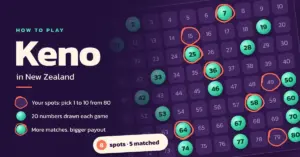
Keno is a fast, frequent numbers game run by Lotto NZ, New Zealand’s official lottery operator. To play, you pick between one and ten numbers from a pool of 1 to 80, choose how much to spend per line, and wait for the draw, when 20 numbers are selected at random. The more of your chosen numbers that match the drawn numbers, the more you win. This guide explains the rules, how many numbers (or “spots”) you can play, how payouts work and where to play — so you know exactly what you are getting before you buy.
What Keno is and how it works in NZ
Keno is a lottery-style game offered by Lotto NZ (the New Zealand Lotteries Commission) under the Gambling Act 2003. The current rules, the Keno Rules 2025, came into force on 29 September 2025. Unlike the main Lotto draw, Keno runs several times a day and lets you decide how many numbers to play.
In every game, a random draw selects 20 winning numbers from the pool of 1 to 80. Your job is to match as many of your own numbers as you can to those 20. You do not need to match all 20 — prizes are paid for matching all, some, or (in some cases) even none of the numbers you played, depending on how many numbers you chose.
Keno at a Glance
| Numbers in the pool | 1 to 80 |
| Numbers you pick (spots) | 1 to 10 per line |
| Numbers drawn each game | 20 |
| Draws per day | Four — 10am, 1pm, 3pm and 6pm (NZ time) |
| Cost per line | $1, $2, $3, $4, $5, $10, $20, $50 or $100 |
| Advertised top prize | NZ$250,000 for a $1 line (match 10 of 10) |
| Odds of matching 10 of 10 | About 1 in 8.91 million |
| Optional extra | Multiplier (1.5x to 10x; doubles the line cost) |
| Where to play | Lotto NZ retail outlets and MyLotto online |
| Claim window | 12 months from the draw date |
How to play Keno in NZ, step by step
Playing a single game of Keno takes only a few choices, whether you are at a Lotto outlet or playing online. Here is the full process from start to finish.
Playing Keno in NZ Step by Step
- Choose how many numbers to play. Decide on your prize group — anywhere from 1 to 10 numbers (your “spots”).
- Select your numbers. Pick them yourself from 1 to 80, or ask for a Dip to have them chosen at random.
- Set your spend per line. Choose how much to stake — $1, $2, $3, $4, $5, $10, $20, $50 or $100 per line; a bigger stake pays a proportionally bigger prize.
- Add the Multiplier (optional). For double the line cost, have any prize you win multiplied by the value drawn (1.5x to 10x).
- Pick how many draws to enter. Play a single draw, or use a multi-draw selection to enter several in a row.
- Buy your entry. Pay at a Lotto outlet or confirm online through MyLotto, and keep your ticket or confirmation.
- Check your numbers. After the draw, compare your numbers with the 20 drawn to see if you have won.
Choosing your numbers: spots and prize groups
The most important decision in Keno is how many numbers you play. In the rules this is called your prize group — the quantity of numbers you select, from 1 up to 10. Most players simply call them “spots”, so playing eight numbers is an “8-spot” game.
How many spots you choose changes the shape of the game:
- Fewer numbers (1 to 4 spots): easier to match all of your numbers, but each prize is smaller.
- More numbers (8 to 10 spots): much harder to match all of your numbers, but the top prizes are far larger, and these groups also pay for partial matches — the 10-spot game even pays a small prize for matching none of the 20 drawn.
There is no “lucky” or “due” number, and no pattern that improves your chances: each draw is independent and every number from 1 to 80 has the same chance of being drawn every time. If you want to understand why charts, trackers and systems make no difference, see our guide to Keno tools and number systems. Picking numbers is purely a matter of personal preference.
How Keno payouts work
What you win depends on four things: how many numbers you played, how many of them matched, how much you spent on the line, and whether you added the Multiplier. Lotto NZ sets a prize table for each prize group, so the value of, say, matching five numbers in an 8-spot game is fixed in advance.
The headline figure is the 10-spot game: matching all 10 numbers on a NZ$1 line pays an advertised top prize of NZ$250,000. The odds of doing that are long — about 1 in 8.91 million — which is why Keno is best treated as entertainment rather than an investment. For comparison with the main draw, you can read more about the odds of winning Lotto in NZ.
A few things are worth knowing about how prizes scale:
- Your stake multiplies the prize. Spending NZ$2 on a line pays double what a NZ$1 line would, and so on for larger amounts.
- There is a maximum prize liability per draw. If the combined value of the top-tier prizes (for matching 7 of 7 through to 10 of 10) in a single game would exceed NZ$2.5 million, each of those prizes is reduced proportionally.
- Playing 10 numbers can pay for matching none. In the 10-spot game, matching none of the 20 drawn numbers returns a small consolation prize.
The Multiplier option
The Multiplier is an optional add-on that can boost your winnings. When you select it, the cost of your line doubles, and a multiplier value of 1.5, 2, 3, 5 or 10 is drawn at random for each game alongside the 20 numbers. Any prize you win is then multiplied by that figure — so a 10x draw turns a $20 win into $200. The Multiplier does not change your odds of matching numbers; it only changes the size of the prizes you do win.
Draw times and where to play
Keno is drawn four times every day, at 10am, 1pm, 3pm and 6pm (New Zealand time). You can enter a single draw or, using a multi-draw selection, the same numbers across several draws in a row.
There are two official ways to buy a Keno entry in New Zealand:
- In store: at any authorised Lotto NZ retail outlet, by filling in a coupon or asking for a Dip.
- Online: through MyLotto, Lotto NZ’s online platform and app, where you log in and buy from the official Keno section on the official Lotto NZ website.
If you would rather not choose numbers yourself, a Dip gives you a randomly generated (computer-generated) set of numbers. If you also play the main draw, our wider guide on how to play Lotto in NZ covers the other games alongside Keno.
Checking your numbers and claiming prizes
After each draw you can compare your numbers with the 20 drawn in the MyLotto app, on the Lotto NZ website, or by asking a retailer to scan your ticket. For the full list of methods, see how to check your Keno results.
Smaller prizes can be collected at a Lotto outlet or paid straight into your MyLotto wallet when you play online. Larger prizes are handled directly by Lotto NZ. You have 12 months from the draw date to claim, after which a prize is forfeited — so check promptly. Our guide on how to claim Lotto winnings explains the thresholds and the identification you may need.
Responsible gambling and disclaimer
This article is for general information only. It explains how Keno works in New Zealand and does not encourage gambling, promise winnings or offer financial advice. Keno is a game of chance: no method, tool or amount of spending can improve your odds, and over time the game is designed to return less than is wagered. Treat it as entertainment and only ever play with money you can afford to lose.
New Zealand does not currently set a minimum age for buying Keno, but the Government has announced a law change to restrict the sale of Lotto NZ products, including Keno, to people aged 18 and over — so treat it as an adults-only activity. If gambling is causing you or someone you know harm, free and confidential help is available around the clock from the Gambling Helpline on 0800 654 655 (or free-text 8006), and from Safer Gambling Aotearoa.
Sources
Frequently Asked Questions (FAQ)
What number comes up most often in Keno?
Over a long enough record some numbers will have appeared slightly more than others, but that tells you nothing about the next draw. Every number from 1 to 80 has exactly the same chance of being drawn in each game, because the draw has no memory of previous results.
Has anyone won $1 million on Keno in NZ?
Yes, a NZ$1 million Keno win is possible. Matching 10 of 10 pays NZ$250,000 for every $1 staked, so a $4 line that matches all ten returns NZ$1 million — though the rules cap the combined top-tier prizes in any single game at NZ$2.5 million, so the very largest wins can be scaled down. Keno results are not publicised the way big Lotto and Powerball jackpots are, so there is no public record we could find of a specific NZ$1 million Keno payout, but the prize structure clearly allows one.
Can AI or software predict Keno numbers?
No. Keno draws are random and independent, so no app, algorithm or artificial intelligence can forecast which numbers will come up. Any tool claiming to do so is selling confidence, not accuracy.
How is Keno different from Lotto in NZ?
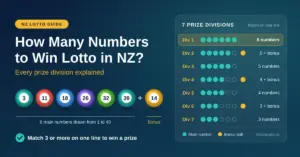
Lotto draws six numbers from a pool of 40, and you play a fixed line. Keno draws 20 numbers from 1 to 80 up to four times a day, and you choose how many numbers to play (from 1 to 10), which makes it faster and more flexible but no easier to win.
What is a Keno “Dip”?
A Dip is a quick-pick option where the system randomly generates your numbers instead of you choosing them. In the Keno Rules 2025 this is called a “computer generated selection”, and it has exactly the same odds as picking those numbers yourself.