Understanding the odds is the single most useful thing you can do before playing Lotto. It turns a vague “you never know” into a clear picture of what you’re actually buying.
This guide lays out the exact chances for every division, how adding Powerball changes them, what extra lines really do, and one change arriving on 13 September 2026 that lengthens the top prize.
Every figure here is per line, and every line has the same chance regardless of whether you picked your own numbers or took a Lucky Dip.
How the draw works
New Zealand Lotto uses a simple matrix: six main balls are drawn from 40, followed by one bonus ball from the remaining 34. To win the top prize you match all six main numbers on a single line.
The number of ways to choose six balls from forty is 3,838,380 — which is exactly why the odds of Division 1 are 1 in 3,838,380.
The draw is independently audited, and the machine has no memory. A line of 1, 2, 3, 4, 5, 6 has precisely the same chance as any scattered spread, because every combination is one of those 3,838,380 possibilities.
Every division, in full
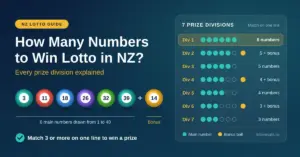
Lotto has seven divisions. As the number of balls you need to match falls, the odds improve sharply.
Six main numbers from 40, plus a bonus ball. Powerball adds a 1-in-10 factor to each.Odds of winning, per line
Division Match Lotto odds With Powerball 1 6 numbers 1 in 3,838,380 1 in 38,383,800 2 5 + bonus 1 in 639,730 1 in 6,397,300 3 5 numbers 1 in 19,386 1 in 193,860 4 4 + bonus 1 in 7,754 1 in 77,540 5 4 numbers 1 in 485 1 in 4,850 6 3 + bonus 1 in 363 1 in 3,630 7 3 numbers 1 in 35 1 in 352
The standard Lotto Division 1 prize is set at $1 million each draw (and can be shared if more than one ticket wins). The lower divisions pay progressively smaller amounts, down to Division 7 — the most common win — which pays a small set prize, typically free tickets. If you want the tiers explained in terms of numbers matched, see our guide to how many numbers you need to win Lotto.
What Powerball does to the odds
Powerball is where the headline jackpots come from — and where the odds get much steeper.
To play, you add one number from a separate machine (currently 1 to 10). Because you now need that exact extra number as well, every Powerball division is simply the matching Lotto division multiplied by ten.
So Powerball Division 1 sits at 1 in 38,383,800 — ten times harder than Lotto Division 1. That’s the real reason the jackpot rolls over for weeks at a time. At the other end, Powerball Division 7 (three main numbers plus the Powerball) is 1 in 352. Note that with Powerball you need at least three main numbers and the Powerball to win anything. For how Powerball is played and priced, see the Powerball NZ guide.
What buying more lines actually does
Almost nobody plays a single line. A coupon needs at least four, and Dips bundle several together. More lines shorten your odds — but only by simple division.
Holding N lines simply divides the single-line odds by N.How extra lines change your Division 1 odds
Lines held Lotto Div 1 Powerball Div 1 1 line 1 in 3,838,380 1 in 38,383,800 4 lines 1 in 959,595 1 in 9,595,950 8 lines 1 in 479,798 1 in 4,797,975 10 lines 1 in 383,838 1 in 3,838,380 12 lines 1 in 319,865 1 in 3,198,650 16 lines 1 in 239,899 1 in 2,398,988
Hold ten lines and you hold ten of the possible combinations, so your Powerball Division 1 odds move from 1 in 38.4 million to 1 in 3.84 million. That’s a real improvement — and still a very long shot. Buying more lines shortens the odds proportionally to what you spend; it never changes the fundamental nature of the bet.
What’s changing on 13 September 2026
If you play Powerball, the odds are about to lengthen.
Powerball Division 1 odds are changing
From 13 September 2026
From 13 September 2026, Lotto NZ adds four more Powerballs, taking the machine from 10 to 14. Because you’ll be picking one number from 14 instead of 10, the odds of Powerball Division 1 move from about 1 in 38.4 million to about 1 in 53.7 million.
In exchange, a new Powerball Division 8 is added and more players win in the lower divisions overall, while the jackpot cap rises from $50 million to $60 million. Importantly, the Lotto-only odds (1 in 3,838,380) don’t change — only the Powerball side does.
Strike and Bullseye
Strike is a separate game played on the first four main Lotto balls, where the order matters. To win the top Strike prize you match all four in the exact sequence they’re drawn — odds of 1 in 2,193,360. Strike pays fixed prizes: matching three in the right positions pays $800, two pays $80, and one pays a free Strike line.
Bullseye, one of the daily games, asks you to match a six-digit target number. With a million possible combinations (000000 to 999999), the top-tier odds are 1 in 1,000,000. Other daily games such as Keno run on entirely different matrices with their own odds — check the official rules for those.
The house edge, in one number
Here’s the figure that puts everything above in context: for every $1 spent on Lotto NZ games, only about 53 cents is returned to players as prizes across all divisions.
That gap is fixed. It doesn’t shrink when the jackpot is large, and it doesn’t move with the day of the week or your choice of numbers. A bigger jackpot makes the top prize more attractive, but it doesn’t improve your odds or the long-run return.
Myths worth retiring
Several popular beliefs simply don’t survive contact with the maths.
“Lucky” stores. Some outlets do sell far more winning tickets than others — a busy Hastings store has sold dozens of first-division tickets over the years. But that’s volume, not luck. A shop selling tens of thousands of tickets a week will naturally register more winners than a small dairy selling a few hundred, while every individual line carries identical odds.
“Overdue” or “hot” numbers. Each draw is independent. The machine has no memory, so a number that hasn’t appeared for months is no more or less likely than any other. Every number keeps the same baseline chance every draw.
Avoiding sequential lines. A line like 10-11-12-13-14-15 has exactly the same probability as any random-looking spread. It only looks unlikely.
There is one genuinely rational tweak, though it doesn’t change your odds: numbers above 31. Because so many people pick birthdays (1 to 31), choosing higher numbers won’t make you more likely to win — but if you do win, you’re less likely to share the prize with others.
Keeping it in proportion
The human brain isn’t built to feel the difference between 1 in 3.8 million and 1 in 38 million — both just register as “a chance.” That’s exactly why a clear-eyed view of the odds matters.
Treat a ticket as money spent on entertainment, with no expectation of return. Set a weekly amount before the jackpot is announced and keep it fixed; don’t buy more because the last ticket lost or because a jackpot has rolled over; and never use money meant for rent, bills or groceries. Online accounts let you set a hard spending limit, which retail buying doesn’t. If tracking the numbers has started to feel less like fun and more like a need, free and confidential support is available at any hour.
Disclaimer: This article is provided for general information only. It does not encourage anyone to gamble, buy lottery tickets, or spend money on any product, and it is not financial, legal or professional advice. Lottery games are games of chance with a negative expected return, and no strategy, number selection, store or purchase channel improves your odds of winning. Odds, prize structures, jackpot caps and rules change — always confirm the current details with Lotto New Zealand at mylotto.co.nz before acting on anything here.
You must be 18 or over to buy or claim lottery products in New Zealand. If gambling is causing harm to you or someone you know, free 24/7 support is available from the Gambling Helpline on 0800 654 655 or by texting 8006, from Safer Gambling Aotearoa, and from PGF Services on 0800 664 262. Gambling in New Zealand is regulated by the Department of Internal Affairs.
Sources used to research and fact-check this article. Last checked 13 August 2026.Reference sources
FAQ
What are the odds of winning Powerball Division 1 in NZ?
Currently 1 in 38,383,800 per line — you must match all six main numbers plus the correct Powerball. From 13 September 2026, with the Powerball drawn from 14 balls instead of 10, the odds lengthen to about 1 in 53.7 million.
What are the odds of winning standard Lotto Division 1?
1 in 3,838,380 per line, for matching all six main numbers. That’s the number of ways to choose six balls from forty, and it isn’t changing in September.
Does buying more lines improve my odds?
Yes, proportionally. Holding ten lines divides the single-line odds by ten, so Powerball Division 1 moves from 1 in 38.4 million to 1 in 3.84 million. It shortens a very long shot but doesn’t change the underlying bet.
Are some Lotto shops luckier than others?
No. Stores that sell many winning tickets do so because they sell a huge volume of tickets, not because of any advantage. Every line has identical odds wherever it’s bought.
Do my odds change if the jackpot is bigger?
No. The number of balls in the machines doesn’t change with the jackpot, so the odds of winning Division 1 are the same whether the prize is $4 million or $40 million.
What are the odds of the top Strike prize?
1 in 2,193,360 for matching the first four main balls in the exact order they’re drawn.
How much of each dollar goes back to players?
About 53 cents in every dollar is returned as prizes across all divisions. That share is fixed and doesn’t change with the jackpot size.