It’s a natural question to ask while waiting in a pre-jackpot queue: how many Lotto tickets does New Zealand actually buy in a week? The honest answer begins with a caveat.
Lotto NZ reports its sales in dollars, not in ticket counts. So there is no official “tickets sold per week” figure, and any precise number you see quoted should be treated with suspicion. What we can do instead is look at the real, published data: total sales, who plays, the retail-versus-online split, and where the money goes.
Key numbers
Figures reported for the financial year ended 30 June 2024.
| Measure | Figure |
|---|---|
| Total sales (FY2024) | $1.71 billion — a record, up 13% |
| Average sales per week | ~$33 million (swings widely with jackpots) |
| Returned to the community (FY2024) | $434 million — a record |
| Returned to communities since 1987 | More than $6 billion |
Lotto NZ reports sales in dollars, not ticket counts, so there is no official “tickets sold per week” figure.
What the sales figures actually show
In the financial year to 30 June 2024, Lotto NZ recorded record sales of $1.71 billion, up 13% on the year before. Spread evenly across a 52-week year, that works out at an average of roughly $33 million a week moving through the system.
But “average” hides a lot. Sales swing dramatically with the size of the Powerball jackpot. Lotto NZ attributed the record year largely to a run of big jackpots, including a $50 million Must Be Won draw and two other draws of $30 million or more. Those events spark “have you got your ticket?” conversations that pull in occasional and casual players who would not otherwise buy.
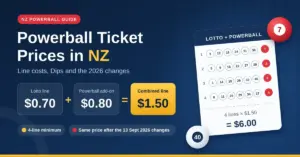
Turning dollars into “tickets” is imprecise anyway, because a single entry can cost anywhere from a few dollars to $28 or more depending on how many lines and games are added. A quiet week and a record-jackpot week are not remotely comparable in volume, which is exactly why one weekly ticket figure would mislead. For what those entries cost, see our guide to Lotto ticket prices in NZ.
How many people play
While ticket counts are not published, participation is well studied through New Zealand’s national health and gambling surveys. Buying Lotto is consistently the single most popular form of gambling in the country. Surveys have found that around two-thirds of adults gambled in some form in the previous year — about 67% in the 2018 Health and Lifestyles Survey, and roughly 64% in the 2023/24 New Zealand Gambling Survey — with Lotto the most common activity by a clear margin. The MyLotto app is also the country’s most common form of online gambling.
Importantly, the picture is one of broad, light participation rather than heavy spending. Lotto NZ describes its own strategy as encouraging many New Zealanders to play, but to spend only a little. Across all gambling types, about 0.5% of adults are classed as problem gamblers, with roughly 2.4% at moderate risk or higher.
Retail versus online
One of the biggest shifts in recent years is not how much is spent, but where the spending happens.
Where tickets are bought
Share of FY2024 sales by channel — now close to even after years of online growth.
| Channel | Share of sales (FY2024) |
|---|---|
| In store (~1,178 outlets) | 54% |
| Online (MyLotto website & app) | 46% |
Online’s share has climbed from about 19% in 2018/19 to roughly 38% by late 2020 and 46% in FY2024. The channel mix affects convenience and record-keeping, not the odds of any line.
In FY2024, about 54% of sales were made in store and 46% online through MyLotto — a near-even split. That balance has moved a long way: online made up roughly 19% of sales in 2018/19, about 38% by late 2020, and 46% by FY2024. On a big Saturday, the central system handles a huge volume of online transactions right up to the 7:30pm cut-off. Our page on playing Lotto online explains how MyLotto works, and has anyone won Lotto online in NZ covers the confirmed digital wins.
The retail network remains substantial — around 1,178 authorised outlets nationwide, mostly independent dairies, bookshops and supermarket counters that earn a commission on sales. Whichever channel you use, the odds of any given line are identical; the split affects convenience and record-keeping, not your chance of winning.
Where the money goes
Every dollar of sales feeds a transparent, audited pipeline. Across a full year, roughly 54% goes back to players as prizes, about 25% to the New Zealand Lottery Grants Board, 12% to taxes, duties and levies, 5% to operating costs, and 4% to retailer commissions and MyLotto fees (FY2024 figures, rounded). Because Lotto NZ is a state-owned Crown entity, 100% of its net profit goes to the Grants Board — a record $434 million in FY2024, and more than $6 billion since 1987 — which funds Sport NZ, Creative NZ, the NZ Film Commission and thousands of community organisations. Our guide on who owns Lotto NZ covers this structure in full.
Why jackpots drive the numbers
The clearest pattern in the data is that demand tracks the jackpot. During a base-level week — the starting Powerball jackpot is $5 million following a game change on 13 September 2026, up from $4 million before — sales follow a gentle, predictable curve. During a long rollover approaching the cap (now $60 million, raised from $50 million in the same overhaul), they surge: more casual buyers, more workplace syndicates, and long queues and online waiting rooms in the final hour before the cut-off. Our guide to Powerball in NZ covers the 2026 changes and the odds.
This is worth understanding about your own behaviour, too. Big-jackpot media coverage is precisely when people who do not normally play tend to spend more than they intended. The odds of the top prize do not improve because the jackpot is large — see our round-up of the biggest Lotto wins in NZ for how rare those wins really are.
Keeping it in proportion
The fact that most of the country plays does not make a ticket a smart financial move. Lotto is designed as low-cost entertainment, not an investment or a way to solve money problems.
A sensible approach is the one Lotto NZ itself promotes: play a little, not a lot. Set a weekly amount before the jackpot is announced and keep it fixed; do not buy extra lines just because a jackpot has rolled over; and only ever spend money that is surplus to rent, bills and essentials. Online accounts let you set a hard weekly spending limit, and if playing ever stops feeling like fun, free and confidential support is available at any hour.
Responsible play and disclaimer
Disclaimer: This article is provided for general information only. It does not encourage anyone to gamble, buy lottery tickets, or spend money on any product, and it is not financial, legal or professional advice. Lottery games are games of chance with a negative expected return. Sales figures, participation data and rules change, and some statistics are estimates — always confirm the current details with Lotto New Zealand at mylotto.co.nz before relying on anything here.
You must be 18 or over to buy or claim lottery products in New Zealand. If gambling is causing harm to you or someone you know, free 24/7 support is available from the Gambling Helpline on 0800 654 655 or by texting 8006, from Safer Gambling Aotearoa, and from PGF Services on 0800 664 262. Gambling in New Zealand is regulated by the Department of Internal Affairs.
Reference sources
- Scoop — Lotto NZ FY2024: $1.71b sales, $434m to community, revenue split
- SunLive — Lotto NZ returns record $434m to the community
- Lotto NZ — About us (profits to the Lottery Grants Board)
- NZ Herald — Lotto Powerball changes from 13 September 2026 (new jackpot floor and $60m cap)
- Ministry of Health — New Zealand Gambling Survey (participation)
- Health NZ — 2018 Health and Lifestyles Survey (Lotto most common)
- Wikipedia — Lotto New Zealand (sales history, retail network)
- Safer Gambling Aotearoa
- Gambling Helpline New Zealand
FAQ
How many Lotto tickets are sold each week in NZ?
There is no official weekly ticket count — Lotto NZ reports sales in dollars, not tickets. Total sales were $1.71 billion in FY2024, an average of roughly $33 million a week, though the figure swings dramatically with the size of the Powerball jackpot.
What are Lotto NZ’s total annual sales?
A record $1.71 billion in the year to 30 June 2024, up 13% on the previous year, driven largely by a run of big Powerball jackpots.
How many New Zealanders play Lotto?
Buying Lotto is the most popular form of gambling in New Zealand. National surveys have found around two-thirds of adults gambled in some form in the past year, with Lotto the most common activity by a wide margin.
Do more people buy tickets online or in store now?
It is close to even. In FY2024, about 54% of sales were in store and 46% online through MyLotto — up from roughly 19% online in 2018/19.
How much goes back to the community?
100% of Lotto NZ’s net profit goes to the Lottery Grants Board — a record $434 million in FY2024, and more than $6 billion since 1987 — funding sport, arts, film and community organisations.
Why do sales jump so much during big jackpots?
Large jackpots pull in occasional and casual players who do not normally buy, along with workplace syndicates, so weekly sales can rise well above the baseline. The odds of winning do not change, only the number of people playing.
Is there a limit on how much I can spend online?
Yes. MyLotto has a maximum weekly (rolling seven-day) spending limit of $150 across all Lotto NZ games. Since 13 September 2026, new players must actively choose their own weekly limit when they sign up rather than starting on the $150 maximum, and any player can set a lower limit at any time.