Every year in New Zealand, a small share of Lotto prizes simply goes unclaimed — tickets left in gloveboxes, coat pockets, or unread emails. Most are tiny. A few, occasionally, are life-changing.
The good news is the system is designed so that unclaimed money always finds its way back to players, and checking an old ticket is quick.
This guide explains the claim deadline, what actually happens to forgotten winnings, the real examples worth knowing, and how to safely check a pile of old tickets. For the full claiming process, see our guide on how to claim Lotto winnings in NZ.
The 12-month deadline
Under the Gambling Act 2003, you have 12 months from the draw date printed on your ticket to claim a prize. Miss that window and the ticket’s barcode is deactivated — a retailer can no longer validate or pay it out, even if you find the winning slip years later.
The 12-month deadline applies to every prize — online included.How long you have to claim
Game Deadline If missed Lotto / Powerball / Strike 12 months from draw date Barcode is deactivated; funds return to the prize pool Instant Kiwi 12 months from game close Panel serial is invalidated; funds return to the prize pool MyLotto — under $1,000 Auto-credited Paid to your wallet automatically — can’t be missed MyLotto — over $1,000 12 months from draw date You’re emailed to claim; still expires if not claimed
The deadline applies to every game, though the details differ slightly. For Instant Kiwi, the 12 months runs from the close of that particular game rather than a draw date. Online is the safest: small MyLotto wins are credited to your wallet automatically, so they can’t be missed — but a large online win still needs you to complete a claim within 12 months, so it isn’t entirely hands-off.
Where unclaimed money actually goes
A common misconception is that forgotten winnings become profit for Lotto NZ or the government. They don’t — and by law, they can’t.
When the 12-month window closes, expired prize money is returned to Lotto NZ’s prize pool (formally, the Prize Reserve Fund) and used to fund future prizes and promotions. In other words, unclaimed money is recycled back to players. Because Lotto NZ is a state-owned organisation whose profits already go to community grants, it has no mechanism to keep unclaimed prizes for itself.
Unclaimed money is rare, mostly tiny — and always goes back to players.Unclaimed prizes by the numbers
To put it in perspective: Lotto NZ has said only about 2% of prizes go unclaimed in an average year, and the roughly $10 million left unclaimed annually is mostly made up of very small prizes. Between 2005 and 2010, about $61.75 million in unclaimed cash was returned to the prize pool. Big wins slipping away entirely is rare — but it does happen.
Real unclaimed and near-miss cases
The genuine stories are striking enough without embellishment.
In 2023, a single Christchurch ticket won $33.5 million in Powerball — and more than a week passed with nobody coming forward, prompting national headlines before the player finally claimed it.
Not every story ends that way. In 2025, an unclaimed $200,000 Lotto First Division prize from the Kāpiti Coast crept toward its expiry date; it had been bought as part of a Father’s Day Triple Dip, leading Lotto NZ to suggest it may have been given away as a gift. The same year, a Masterton First Division prize sat unclaimed with the deadline looming. On the more hopeful side, unclaimed $500,000 prizes in Pāpāmoa and Auckland were eventually reunited with their winners after public appeals.
Over one recent five-year stretch, only two First Division prizes — each $500,000 — expired completely unclaimed. Rare, but a real reminder to check your tickets.
How Lotto NZ hunts for mystery winners
Because a standard paper ticket carries no name or phone number, Lotto NZ can’t simply call an unclaimed winner. So when a significant prize goes unclaimed for around three months, it turns to the media.
Lotto NZ publicises the specific store where the winning ticket was sold, along with the date and rough time of purchase, and asks the public to check their tickets. This works especially well in smaller towns, where locals quickly notice if their corner dairy is on the evening news. For online players who’ve won over $1,000, Lotto NZ can see when an account was last active and email a reminder to log in and claim.
If you’ve lost a winning ticket
Losing a ticket isn’t always the end of the road. If a ticket is lost — and assuming nobody else has found and claimed it — Lotto NZ may still be able to pay the rightful owner if they can provide specific details about the purchase.
Every Lotto outlet holds a Lost, Stolen or Damaged Ticket form that goes to the claims team for investigation. You’ll need as much detail as possible: the store, the date and rough time, the amount spent, the payment method, and the numbers you played. There’s no guarantee of payment, which is the strongest argument for signing the back of every ticket the moment you buy it.
Checking old tickets safely
If you’re clearing out a drawer or a glovebox and find a stash of old tickets, checking them is simple — and worth doing, since small division prizes add up.
Small division prizes add up, so it’s worth checking every slip. Gather every slip and order them by the draw date printed on the front, so you can spot anything near the 12-month limit. Make sure the barcode area is clean, dry and free of deep tears or pen marks so a scanner can read it. Use the MyLotto app’s camera scanner for a private check, or hand the tickets to any Lotto outlet to run through the terminal. If a ticket is a winner, check the draw date falls within the last 12 months. Outside that window, the barcode is expired. Sign the back of any winning ticket before handing it over, and claim promptly.Found a pile of old tickets? Check them safely
Sort by draw date
Check the barcode is readable
Scan at home or in store
Confirm it’s in date
Sign before you claim
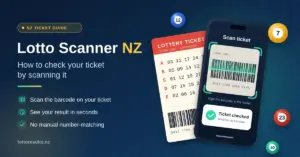
The easiest method is the MyLotto app’s built-in scanner, which reads the barcode privately at home. Alternatively, any Lotto outlet can run your tickets through the terminal. Our Lotto scanner guide covers how scanning works, and you can always compare numbers by hand against the published Lotto results.
Protecting a paper ticket
A lottery ticket is a bearer document — whoever physically holds it is generally treated as the owner. That’s why an unsigned ticket is a real risk: if it’s lost and someone else finds it, they could claim a small cash prize at a counter without showing ID.
Two habits remove most of that risk. Sign the back the moment you buy, and store tickets somewhere consistent and dry — a dedicated wallet slot or a clip on the fridge — away from the wash cycle that ruins so many. Playing on MyLotto avoids the problem entirely, since entries are tied to your account and checked automatically; see our Lotto online page for how that works.
Charity and community lotteries
Lotto NZ isn’t the only game in town. Community and charity lotteries — such as those run by rescue helicopter trusts or health foundations — are separate operations, licensed by the Department of Internal Affairs under the Gambling Act.
These set their own claim terms and unclaimed-prize rules, which can differ from Lotto NZ’s, and are often shorter. If you hold a ticket in a charity or house lottery, check that specific lottery’s terms and conditions rather than assuming the 12-month Lotto rule applies.
Disclaimer: This article is provided for general information only. It does not encourage anyone to gamble, buy lottery tickets, or spend money on any product, and it is not financial, legal or professional advice. Lottery games are games of chance with a negative expected return. Claim deadlines, prize rules and procedures change — always confirm the current details with Lotto New Zealand at mylotto.co.nz before acting on anything here.
You must be 18 or over to buy or claim lottery products in New Zealand. If gambling is causing harm to you or someone you know, free 24/7 support is available from the Gambling Helpline on 0800 654 655 or by texting 8006, from Safer Gambling Aotearoa, and from PGF Services on 0800 664 262. Gambling in New Zealand is regulated by the Department of Internal Affairs.
Sources used to research and fact-check this article. Last checked 13 August 2026.Reference sources
FAQ
How long do I have to claim a winning Lotto ticket in NZ?
Twelve months from the draw date printed on the ticket (or, for Instant Kiwi, 12 months from the close of that game). After that, the barcode is deactivated and the prize can no longer be claimed.
What happens to unclaimed Lotto prize money?
It’s returned to Lotto NZ’s prize pool (the Prize Reserve Fund) and used to fund future prizes and promotions. Because Lotto NZ is state-owned, it can’t keep unclaimed money as profit — it goes back to players.
How often do prizes actually go unclaimed?
Rarely. Lotto NZ has said only about 2% of prizes go unclaimed in an average year, and the roughly $10 million left unclaimed annually is mostly very small prizes.
Can I still claim if my ticket is past 12 months old?
No. If you scan a ticket more than 12 months past its draw date, the system will show it as expired, and no outlet can pay it out.
How would I know if my local shop sold an unclaimed winning ticket?
When a significant prize stays unclaimed for around three months, Lotto NZ publicises the store, suburb and purchase date through the media, and asks people to check their tickets.
Do online MyLotto tickets expire?
Small online wins (under $1,000) are credited to your wallet automatically, so they can’t be missed. But a large online win still requires you to complete a claim within the 12-month window.
If I lose an unsigned ticket, can someone else claim it?
Potentially, yes — a ticket is a bearer document, so whoever holds it is generally treated as the owner. Signing the back straight after purchase is the simplest protection.