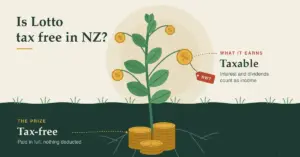
Yes. Prize money from Lotto, Powerball, Strike, Keno and the other draws run by Lotto NZ is not taxed in New Zealand. Inland Revenue (IRD), the government’s tax agency, does not treat a lottery prize as income, so you receive the full advertised amount: a $1 million Division 1 prize arrives as $1 million, with nothing deducted. The same tax-free treatment applies to raffles and other prize draws.
The catch is not the prize — it is what the money does next. Once you save or invest your winnings, the returns they produce are income, and income is taxable. Understanding where that line falls is what the rest of this guide is about. You can read more about what happens when you win Lotto if you want the full step-by-step picture.
At a glance
| What you receive | How it is treated |
|---|---|
| Lotto, Powerball, Strike or Keno prize money | Tax-free — not treated as income by Inland Revenue |
| Interest from savings accounts or term deposits | Taxable — resident withholding tax (RWT) applies |
| Dividends from shares, or rent from property bought with winnings | Taxable income |
| Gifting money to family or friends | No gift duty (abolished 1 October 2011) |
| Passing winnings on to others later | No inheritance or estate tax in New Zealand |
| Income from winnings while on a benefit | Interest, dividends and rent must be declared to Work and Income |
Why lottery prizes are not taxed in New Zealand
New Zealand taxes income — money that comes in regularly from work, a business, or an investment. As Inland Revenue puts it, “Generally, if someone wins a raffle, Lotto or prize money in a draw, these winnings are not taxable.” A one-off win from a game of chance is not earned income, so there is no tax to pay on the prize itself, whether it is a modest Strike prize or one of the biggest Lotto wins in NZ.
There is one narrow exception. IRD says prize money won as part of someone’s taxable activity can be taxable and must be declared. Its own examples are a farmer who wins money for an exhibit at an agricultural show, an author who wins prize money for one of their books in a competition, and a professional sportsperson’s prize winnings. For an ordinary player who buys a ticket for fun, this does not apply.
The part that can be taxed: interest and investment income
This is where most of the real tax sits. Your prize is tax-free, but the moment you put it to work, the earnings become taxable income. The main ways this happens are:
- Bank interest. Interest from a savings account or term deposit is taxable. Your bank deducts resident withholding tax (RWT) — tax taken out of interest before it is paid to you — at a rate based on your income, then passes it to IRD.
- Dividends from shares. If you buy shares or managed funds, the dividends and distributions you receive are taxable.
- Rental income. If you buy a property with your winnings and rent it out, the rent is taxable income.
The scale can be significant. Place $500,000 in a term deposit paying 5% and it earns about $25,000 a year in interest — and that interest is taxable, even though the $500,000 that generated it never was. For a major Powerball jackpot, the interest alone can run into hundreds of thousands of dollars a year, all of it taxed as normal income.
Giving winnings away: gift duty and family
Sharing a win with family is common, and New Zealand makes it straightforward. Gift duty was abolished on 1 October 2011, so you can give money to relatives or friends without paying a tax on the gift itself. New Zealand also has no inheritance tax or estate duty, so money passed on later is not taxed on transfer either.
A few practical points remain. Very large gifts can have implications for relationship property or for anyone receiving a government benefit (see below), and setting up a trust to manage a big win has its own legal costs. Gifting removes the gift-duty question, not the need for good advice.
Winnings, benefits and NZ Superannuation
If you receive a benefit, the rules are specific and worth getting right. According to Work and Income:
- The one-off win usually does not need to be declared. One-off lottery or gambling winnings generally do not count as income for a benefit — unless you get Accommodation Supplement, Temporary Additional Support or Special Benefit, in which case you do need to tell Work and Income.
- Ongoing income from the win does need to be declared. Any interest, dividends or rent you earn from saving or investing the money is counted as income and must be reported, because it can affect your payments.
- Gifting can matter too. Giving part of the money away may affect a benefit, so check before you do.
Work and Income lists NZ Super or Veterans Pension with a Non-qualified Spouse among its income-tested payments. If you receive one of those, any interest, dividends or rent you earn on your winnings counts as income and must be reported to Work and Income, and that investment income is taxable in the normal way.
Overseas lottery winnings and tax residence
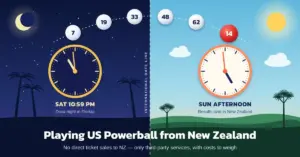
The tax-free treatment described here applies to New Zealand tax residents. If you are a Kiwi resident who wins an overseas draw, two things are worth knowing. First, some countries tax lottery prizes at the source — the United States, for example, requires the payer to withhold federal tax on larger lottery winnings before paying out (generally 24%, and around 30% for overseas winners) — so an overseas prize is not always handed over in full. Second, as a New Zealand resident you are taxed on worldwide income, so any interest or investment income you earn on those winnings is still taxable here. If you are weighing up an international draw, our guide to playing US Powerball from New Zealand covers how entry actually works.
Getting paid: how NZ Lotto prizes are handed over
Prizes under $1,000 are paid out immediately, either in store or straight into your MyLotto wallet if you played online. For a prize over $1,000 you complete a claim form, and Lotto NZ says it aims to pay most claims within about seven working days of receiving them. Winners have up to 12 months from the draw date to claim. For the exact steps and documents involved, see how to claim your Lotto winnings. Because the full amount is tax-free, the sum you claim is the sum you keep.
Disclaimer
This article is general information about how New Zealand tax rules treat lottery winnings. It is not tax, legal or financial advice, and it does not encourage gambling or spending. Tax outcomes depend on your own circumstances, and rules can change — confirm the current position with Inland Revenue or a qualified tax adviser before making decisions about a large win. Lotto is best treated as entertainment rather than a way to make money; the odds of winning Lotto are long. If gambling is causing you or someone you know harm, free, confidential help is available through the Gambling Helpline on 0800 654 655, and you can read more about responsible gambling.
Sources
- Inland Revenue — Taxing prize money
- Inland Revenue — Income under ordinary tax rules
- Inland Revenue — Resident withholding tax (RWT)
- Inland Revenue Tax Technical — Gift duty abolition
- Work and Income — Lottery and gambling winnings
- IRS — Instructions for Forms W-2G and 5754 (gambling withholding)
- RNZ — How Lotto pays out prizes
- 1News — What happens to Lotto’s unclaimed prizes?
- Gambling Helpline Aotearoa
Frequently Asked Questions
How long does it take for Lotto to pay out in NZ?
Prizes under $1,000 are paid immediately, in store or into your MyLotto wallet online. For larger prizes you complete a claim form, and Lotto NZ says it aims to pay most claims within about seven working days. You have up to 12 months from the draw date to claim your prize.
What should you do if you win Lotto in NZ?
Check and secure your ticket, then claim it. Wins under $1,000 can be collected in store or through MyLotto straight away; for anything over $1,000 you fill in a claim form and Lotto NZ processes the payment, usually within about seven working days. For a large, life-changing amount it is worth getting financial and legal advice before you decide what to do with the money.
Do I have to tell Work and Income if I win Lotto?
A one-off win usually does not need to be declared, unless you receive Accommodation Supplement, Temporary Additional Support or Special Benefit. However, any ongoing interest, dividends or rent you earn from the money must be reported, as it can affect your payments.
Can I give winnings to my family without paying tax?
Yes. New Zealand abolished gift duty on 1 October 2011 and has no inheritance or estate tax, so you can share a win with family or friends without a tax on the transfer. Large gifts can still affect benefit entitlements, so take advice first.
Are winnings from overseas lotteries tax-free for New Zealanders?
For a New Zealand tax resident the overseas prize is generally not taxed in New Zealand, but some countries withhold tax at the source before paying out. Any interest or investment income you then earn on those winnings is taxable in New Zealand.