When people type “lotto near me” into a phone, they are almost always trying to do one of two things: buy a ticket before sales close tonight, or find out whether the paper ticket in their pocket has won anything.
This guide answers both, in plain language.
It explains how New Zealand’s retail network is set up, exactly when ticket sales stop, the age-rule change that took effect in 2026, and what actually happens when you hand a winning ticket across a counter.
Who runs Lotto in New Zealand
Lotto is run by Lotto New Zealand, the organisation behind the MyLotto website and app.
It is a Crown entity, which simply means it is owned by the government rather than a private company. It was set up in 1987 and operates under the Gambling Act 2003. Two things follow from that: the games are tightly regulated, and the profits do not go to private shareholders.
Here is the part that trips people up. Lotto NZ does not own the shops that sell its tickets. It licenses ordinary, independent businesses to run a Lotto terminal on its behalf.
So there is no such thing as a “Lotto branch” the way a bank has branches. The terminal simply sits inside a supermarket, a dairy, a bookshop or a mall kiosk. If you want to know more about the ownership structure, our page on who owns Lotto NZ goes into detail.
One visit covers most of the range.
Lotto, Powerball and Strike are the twice-weekly draw games. Keno and Bullseye are drawn every day. Instant Kiwi scratch cards are sold alongside them, and have always carried a firm age limit.
To compare the draw games in more depth, see the Powerball NZ guide and the Instant Kiwi overview, which explain how each game is played and what the prizes look like.
How to find your nearest Lotto outlet
The most reliable way to find an outlet is the official store finder on the Lotto NZ website or the MyLotto app, because that list comes straight from the operator.
Third-party business directories are a weaker option. They often still list shops that have closed, or shops that never had a terminal in the first place.
When you are out and about, a phone map is the quickest tool. Search a term like “Lotto” or “Lotto shop” with location services switched on, and nearby stores will appear along with whether they are currently open.
Two cautions are worth remembering:
- A map shows the shop’s opening hours, not the terminal’s selling window. A dairy being open at 8 pm on a Saturday does not mean you can still buy into that night’s draw.
- Reviews and photos can help you confirm a store actually has a Lotto counter, rather than just selling milk and bread.
Because the terminal lives inside another business, it helps to know the usual hosts.
| Type of outlet | Where you’ll see them | Worth knowing |
|---|---|---|
| Supermarkets | Woolworths, New World, PAK’nSAVE | Usually a service desk or kiosk near the entrance |
| Dedicated Lotto shops | Malls and main streets | Often the fastest option close to the 7:30 pm cut-off |
| Dairies and convenience stores | Suburban shopping strips | Not every dairy has a terminal — look for the Lotto sign |
| Bookshops and stationers | Paper Plus and similar | Commonly stock Instant Kiwi as well as draw games |
| Petrol stations and post shops | Main routes and town centres | Availability varies a lot from site to site |
Lotto NZ does not run its own shops. It licenses independent businesses to host a terminal, and the network runs to around 1,178 authorised outlets nationwide (Lotto NZ 2024 financial year). That number shifts as stores open, close or hand back a terminal. Authorised stores show the yellow-and-blue Lotto signage; if you are unsure, check the official store finder before you travel.
Draw days and the 7:30 pm cut-off
Lotto is drawn twice a week, on Wednesday and Saturday.
The single most useful fact to remember is the cut-off. Ticket sales close at 7:30 pm on a draw night, and that time is the same everywhere in the country and on every channel, whether you buy in a shop or on MyLotto.
Sales close at the same time nationwide, in store and on MyLotto.Lotto NZ draw schedule & ticket cut-off
Game Draw days Draw time Lotto Wed & Sat ~8:20 pm Wed, ~8:00 pm Sat Powerball Wed & Sat Drawn straight after Lotto Strike Wed & Sat Uses the first four Lotto balls
Reach the counter at 7:31 pm and the terminal will still happily sell you a ticket — but it will go into the next draw, not that night’s.
The reason the deadline feels stricter than people expect is that it is set centrally by Lotto NZ, not by the shop. Staff cannot override it, and there is no grace period for someone standing in a queue. During big jackpots, queues at popular stores build well before 7:30 pm, and Lotto NZ has previously used an online virtual queue in the final hour before sales close.
On non-draw days you can buy in advance, and a single playslip can enter several consecutive draws at once. For more on scheduling, see our guide to Lotto draw times in NZ.
The age rule and what changed in 2026
For years, Instant Kiwi was the only Lotto NZ product with a legal age limit. Under the Gambling Act 2003 it can only be bought by people aged 18 or over, and it is an offence to buy one for someone younger — even as a gift.
That left an odd gap: children could technically buy a twice-weekly Lotto ticket.
That gap has now been closed. In May 2026, Parliament passed the Regulatory Systems (Internal Affairs) Amendment Bill, which extends the 18+ restriction to all lottery products, including the standard Lotto draw. The Minister of Internal Affairs described it as a straightforward change to make the age rules clear to retailers and consumers, so children are not allowed to gamble by accident.
In practice, expect to be asked for ID at a counter if you look under 25. Lotto NZ already runs a “mystery shopper” programme that quietly tests whether stores check identification. If you need certainty about the exact date a provision took effect, confirm the current position on the official Lotto NZ website.
How to check a paper ticket
You have three ways to check a ticket, and none of them means going back to the shop where you bought it.
- At the counter. Hand the ticket to the operator, who runs it through the terminal. A tone sounds and the customer screen shows the result.
- A self-service scanner. Many larger stores have one. Hold the barcode under the reader and the screen shows the outcome.
- Your phone. The MyLotto app has a built-in scanner that reads the barcode and checks it against the published results. Our Lotto scanner guide shows how it works, and you can always compare your numbers by hand against the published Lotto results.
One thing does not work in reverse: a ticket bought on MyLotto cannot be checked or claimed at a shop, because it only exists inside your online account.
Claiming a prize at a Lotto outlet
How a win is paid out depends entirely on the amount.
Powerball changes at a glance
From 13 September 2026What changes Now From 13 Sep 2026 Powerballs in the machine 10 14 Prize divisions Up to Div 7 New Div 8 added Starting jackpot $4 million $5 million Maximum jackpot $50 million $60 million Div 1 odds (per line) ~1 in 38.4m ~1 in 53.7m Weekly winners (all divisions) ~47,000 ~62,000 Price to play Unchanged
In short: prizes of $1,000 or less are paid at any Lotto NZ outlet, usually on the spot, either as cash or as a refund onto your EFTPOS card. Because each shop manages its own cash float, a small dairy may prefer the card option.
Prizes above $1,000 are still handled at any outlet, but the money does not come over the counter. You hand over the ticket, fill in a Prize Claim Form, provide your bank details, and the retailer couriers the paperwork to Lotto NZ’s head office for payment.
For a Lotto or Powerball First Division win, the retailer contacts Lotto NZ while you are still in the store and puts you through to the winners’ team. The paperwork is handled discreetly, away from the counter, and winners can choose to stay anonymous.
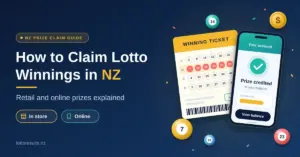
Whatever the amount, a prize must be claimed within 12 months of the draw date printed on the ticket. There is a fuller walkthrough in our guide on how to claim Lotto winnings in NZ. Lotto NZ keeps all winning tickets, so photograph yours first if you want a record. When you claim a small prize in store, the operator tears and keeps the ticket once it is marked paid. That is normal: it stops an old winning slip being claimed a second time somewhere else.
In store or on MyLotto: the real differences
Neither channel changes your odds. Every difference is about convenience, record-keeping and risk.
A paper ticket needs no account and no ID check at the point of sale, and leaves no digital trail. The trade-off is that you are responsible for keeping it safe.
A MyLotto ticket cannot be lost, is checked automatically, and pays small prizes straight into your account balance. In exchange, it requires a registered account and comes with a built-in spending limit: Lotto NZ applies a rolling seven-day online spend cap of $150 across all games.
If you are weighing the two up, our page on playing Lotto online explains how MyLotto accounts work in more detail. And if you are curious about your actual chances either way, see the odds of winning Lotto in NZ.
Looking after a paper ticket
A lottery ticket is a bearer document. That means whoever physically holds it is generally treated as the owner — which is exactly why an unsigned ticket dropped on the footpath is a genuine risk.
The simplest protection is to write your name on the back straight away. Lotto NZ itself urges people to do this whenever a large prize is sitting unclaimed.
If a ticket is torn, it is usually still fine as long as the barcode can be read. If it cannot, every Lotto NZ store holds a Lost, Stolen or Damaged Ticket form that goes to the claims department for investigation. You will need as much detail as possible — the store, the date and rough time of purchase, the amount spent, the payment method, and the numbers or Dip you played. Bank statements can help. There is no guarantee of a payout, which is the strongest argument for signing a ticket the moment you buy it.
Powerball is changing from 13 September 2026
If you play Powerball, the game you buy after mid-September 2026 will not be quite the same one.
How the claim is handled depends entirely on the amount you’ve won.Claiming a paper ticket: what happens at each level
Paid at any Lotto NZ outlet, usually straight away
Still any outlet, but not paid over the counter
The retailer contacts Lotto NZ while you’re in the store
Lotto NZ is adding four more Powerballs to the draw machine, taking the count from 10 to 14 — its first “matrix change” in 19 years — and introducing a new Powerball Division 8. The starting jackpot rises from $4 million to $5 million, and the maximum from $50 million to $60 million.
The trade-off is honest. More balls means more possible combinations, so the odds of winning Powerball Division 1 lengthen from roughly 1 in 38.4 million to about 1 in 53.7 million. Lotto NZ expects the total number of weekly Powerball winners across all divisions to rise by around 30%, from about 47,000 to 62,000, while the very top prize is won less often. The price to play is not changing.
Where the money goes
Lotto NZ’s profits are passed to the New Zealand Lottery Grants Board, which funds community, arts, sport and recreation organisations. Since it began, Lotto NZ has returned more than $5.9 billion to the board, with the New Zealand Film Commission, Creative New Zealand and Sport New Zealand among the largest recipients.
This is a real feature of the model, not a marketing line — but it is not a reason to buy a ticket. A ticket is a bet with a negative expected return, and there are far more efficient ways to support a community group if that is your goal.
Keeping it in proportion
Buying at a counter has none of the built-in controls that an online account has. There is no ledger, no weekly cap, and nothing to flag a pattern building up. The discipline has to come from you.
A few habits help:
- Decide a weekly amount before the jackpot is announced, and keep it fixed no matter how high the prize climbs.
- Treat the cost like a coffee: money already spent, in exchange for a few days of anticipation.
- Don’t chase losses by buying more tickets, and never use money set aside for rent, food or bills.
Retail staff are trained to notice continuous or unusual buying, and a store can decline a sale. If your spending has started to feel uncomfortable, free and confidential support is available in New Zealand at any hour of the day.
Disclaimer: This article is provided for general information only. It does not encourage anyone to gamble, buy lottery tickets or spend money on any product, and it is not financial, legal or professional advice. Lottery games are games of chance with a negative expected return, and no strategy, store or set of numbers improves your odds. Rules, prices, prize thresholds and legal requirements change, so always confirm the current details with Lotto New Zealand at mylotto.co.nz before acting on anything here.
You must be 18 or over to buy lottery products in New Zealand. If gambling is causing harm to you or someone you know, free 24/7 support is available from the Gambling Helpline on 0800 654 655 or by texting 8006, from Safer Gambling Aotearoa, and from PGF Services on 0800 664 262. Gambling in New Zealand is regulated by the Department of Internal Affairs.
Separate bodies handle policy, regulation, finances and draw integrity. A government-owned organisation — no private shareholders.Who oversees Lotto NZ
Lotto NZ ownership at a glance
Legal name New Zealand Lotteries Commission Trading as Lotto New Zealand (since 2013) Owner The New Zealand Crown (the public) Entity type Crown entity Established June 1987 Responsible Minister Minister of Internal Affairs Chief Executive Jason Delamore Board Chair Mark Todd (appointed 2024) Profits go to NZ Lottery Grants Board (Te Puna Tahua)
FAQ
What time do Lotto ticket sales close on draw nights?
Sales close at 7:30 pm on Wednesdays and Saturdays, everywhere in the country and on every channel. A shop can stay open much later, but after 7:30 pm the terminal will only sell you a ticket for the next draw.
Do I have to be 18 to buy a Lotto ticket in New Zealand?
Yes. Instant Kiwi has always been restricted to people aged 18 and over, and a law passed in May 2026 extends the 18+ rule to all lottery products, including the twice-weekly Lotto draw. Expect to be asked for ID if you look under 25.
Can I claim a MyLotto prize at a shop?
No. Online tickets exist only in your MyLotto account. Small prizes are credited automatically, and larger amounts use an online Prize Claim Form. Retail counters can only validate and pay physical tickets printed from a terminal.
How long do I have to claim a prize?
Twelve months from the draw date printed on the ticket. After that the prize can no longer be claimed and the money returns to the prize pool.
Do I pay tax on Lotto winnings?
No. Lottery prizes are not treated as income in New Zealand, so the prize itself is tax-free. Any interest or investment income you later earn on that money is taxed normally. This is general information, not tax advice.
What happens if my ticket is torn or damaged?
If the barcode is still readable, a terminal can usually process it. If not, every Lotto NZ store holds a Lost, Stolen or Damaged Ticket form that goes to the claims team for investigation. There is no guarantee of payment, which is why signing the back when you buy is worth the two seconds.
Can I buy a Lotto ticket at any dairy?
Only at dairies that hold an official Lotto NZ terminal, and not every one does. Authorised stores display the yellow-and-blue Lotto signage. If you are not sure, check the official store finder first.
Is it better to buy in store or online?
Neither improves your chances. A paper ticket needs no account and leaves no digital record, but you must keep it safe. An online ticket cannot be lost and is checked automatically, but needs a registered account and comes with a mandatory spend limit.